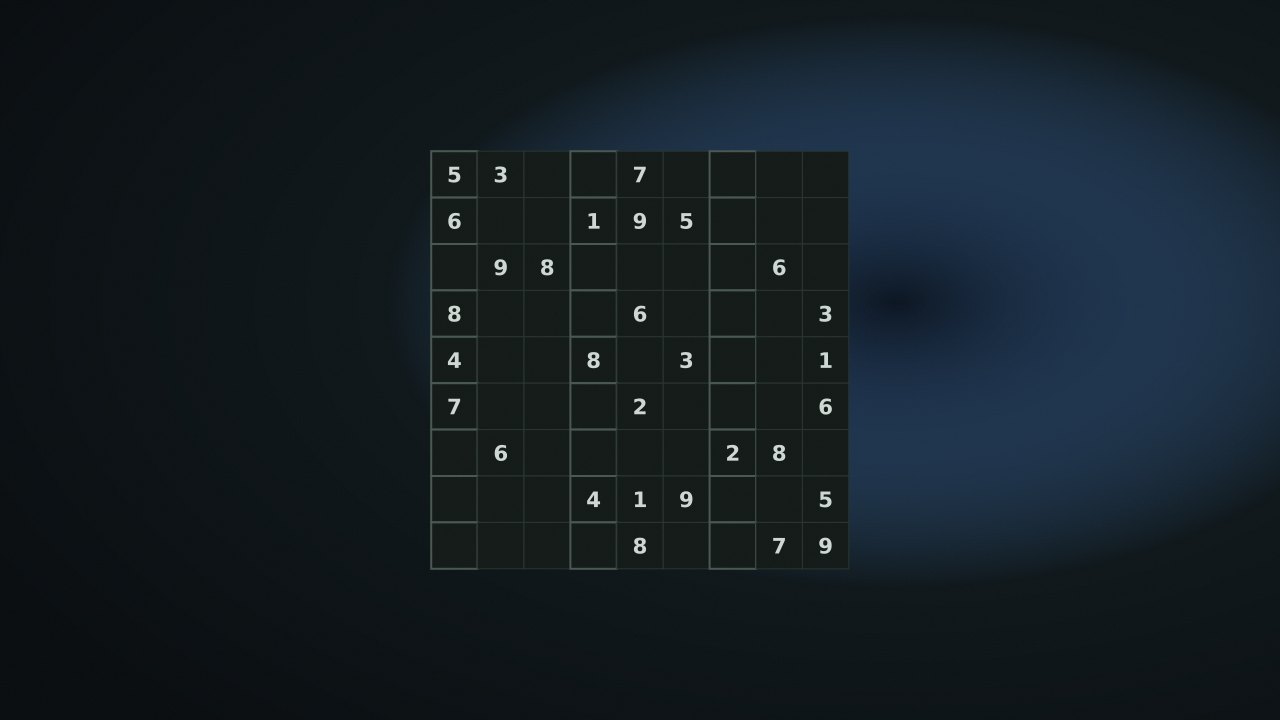
Sudoku 9×9
Sudoku 9×9 on NoCharge — uniqueness first, labels second
Why the 9×9 generator verifies exactly one solution, and why difficulty is reported as a given count instead of a grade or "brain level".
- sudoku
- puzzle generation
- honesty
Controls at a glance
About this game
Sudoku 9×9 expands the puzzle to nine rows, nine columns, and nine 3×3 boxes. Every placement has to satisfy all three units, so a digit that fits a row can still be ruled out by its box.
Complete the grid with digits 1–9, each occurring once in every row, column, and box. Original clues are fixed. Incorrect attempts do not use lives and there is no countdown; Clear, Undo, Check, and a selected-cell Reveal are separate controls.
Choose an editable square and enter a digit with the keyboard or number pad. Turn on Marks to keep candidate notes in an empty cell. Those notes are your working list rather than an automatic solution.
Suppose a cell’s row is missing 2, 7, and 9. If its column already contains 7 and its box already contains 9, only 2 remains. Conversely, if a digit is a candidate in only one empty square of a box, that box forces its location even when the square has other candidates. Check tests entered digits against the solution; Reveal fills only the selected cell.
There is no speed score. The current presets request 42, 34, or 28 givens for Easy, Medium, or Hard, with the generator preserving a unique solution. Clue count is not a promise that one puzzle needs a particular solving technique or amount of time.
Start with constrained units and cross-reference their candidates. When a placement changes a row or box, update your notes there before adding more. Keeping notes consistent is more useful than filling every empty square with all nine digits.
nocharge:sudoku9:current-puzzle holds the difficulty, seed, and board digits. Valid saved boards can resume on reload; individual notes and Undo history are not restored. nocharge:sudoku9:puzzles-solved counts completed grids, while nocharge:pref:sudoku-pencil-marks remembers the Marks toggle shared with Mini Sudoku. Clearing local game data removes these browser-only records.
Player notes
Original articles about the systems and decisions inside Sudoku 9×9.
Sudoku 9×9
Why the 9×9 generator verifies exactly one solution, and why difficulty is reported as a given count instead of a grade or "brain level".
The full grid, at your own pace. Classic 9×9 Sudoku with 3×3 boxes, pencil marks, check, and reveal-one-cell. Easy/Medium/Hard are labeled by given count (42/34/28) and every puzzle has one verified solution. Untimed.
Yes. The game opens without an account, subscription, or cloud profile.
Fill: Select a cell and type 1–9, or use the on-screen digit pad. Pencil marks: Toggle Marks, then enter digits in an empty cell to keep candidate notes. Clear or undo: ✕ or Backspace clears the selected cell; U undoes the last entry. Check or reveal: Check highlights wrong cells; Reveal fills only the selected cell. Difficulty: Easy 42 givens, Medium 34, Hard 28 — labels describe the given count, and every puzzle has exactly one solution.
Any result or preference the game retains is stored in local storage in this browser. It does not synchronize between devices and can be removed with Clear game data.
The shared game shell pauses while the page is hidden and stops ambient audio. Returning removes the hidden-page pause, but a manual pause remains in place.
Use New game in the shared toolbar or settings panel. Restarting this game does not clear saved results from other games.
The listed session is 8–25 min. Check the complete guide for mode-specific timing, scoring, and end conditions.
Master mute silences effects and ambient audio. Effects on/off changes game effects only, and the volume control also adjusts an active ambient texture.